
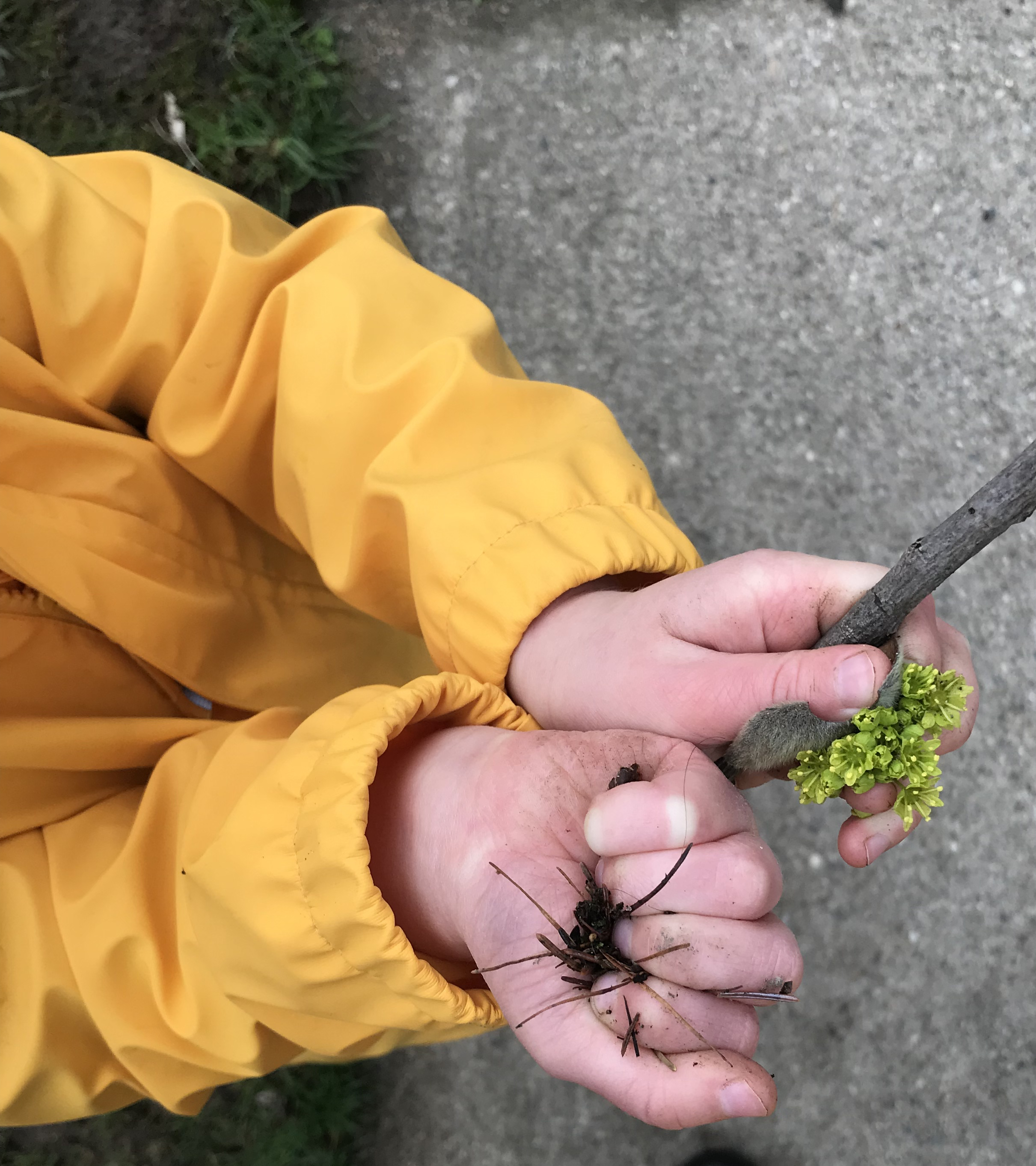
I know a wonderful little four year old who loves to collect little bits of everything. One day this spring he scooped up violets, buds from maple trees, a fallen husk from a magnolia bud, a stick, and a few other odds and ends. He kept collecting items and showing them to me, exclaiming over each one. “Isn’t it fun that I have my own dirt, and my own stick, and my own plants, and my own buds that fall off of trees? Look at my collection!” I did look. Spring was bursting forth all around us, yet his small eyes saw wonder, entertainment, and joy in the the most overlooked of the spring things. Each worm for him is both a marvel and a friend.
I have been realizing lately how much I have learned, how much I continue to learn, from simple delight. It isn’t just a nice bonus, a bright spot in an otherwise mundane day. It has something to say, and a way of forming us. Unfortunately, we tend to be a little patronizing toward delight. It is something small, fleeting, perhaps even reserved for children. It isn’t, anyway, seen as a very serious thing. We might describe it as naive or frivolous, even, but certainly not essential. But I think we’re missing out on something important. I think that, actually, delight is deeply wise.
We spend so much time wrapped up in the overwhelming seriousness of the world— the suffering, the death, the despair. Or even just the hard work, the quotidian, and the mediocre. And the time we spend in those spaces shapes us. It forms our imaginations for what is possible, and so often it curtails our vision, preventing us from recognizing the beautiful things right in front of our eyes. When was the last time we looked adoringly at our own dirt, grateful down to our toes that we have it?
I have found solace and instruction recently in Ross Gay’s beautiful work The Book of Delights. In this book, he tasked himself with writing a mini essay each day about something that delighted him. He wrote quickly, extemporaneously, without getting too serious about it, and he found that the more he did this, the more delight he found. It was a muscle, he said. Taking delight opened his eyes to further delights. It trained his imagination, it helped him to see what is possible, and even what is already present. Taking delight is so far from putting an optimistic lens over something difficult. It isn’t looking on the bright side or finding a silver lining. I think that it is actually a practice in making sure that we are seeing the world as it really is— the heartbreaking and the beautiful all muddled together. It is a refusal to ignore either. It isn’t a practice of making up happy things, it is an act of resistance, a refusing to let go of the delightful things that already are.
Flannery O’Connor once wrote in her prayer journal “God is feeding me and what I’m praying for is an appetite.” I think delight is just like that. God is feeding us all the time. There is so much that is worthy of delight that we move past without really seeing it. Learning to take delight is a small way that we can practice seeing and celebrating. We can develop a hunger for all the good things, whether tiny or enormous, that are already present to us. This of course is not to ignore or elide the difficult things we are faced with. It is just to say that we perhaps should not let those things become the only things that form us, the only things that shape our imaginations and teach us what to expect for ourselves. What would it look like to start a collection of our own, stringing delights together like beads on a necklace, exclaiming to the world, “come and see!”
 Wellspring
I love this! “God is feeding me and what I am praying for is an appetite.” I too am learning the value of delight. I find that my capacity for delight is linked to my capacity for deep love. And since love is God’s primary command, I think we ought not overlook or undervalue delight.
LikeLike