
By Wiert
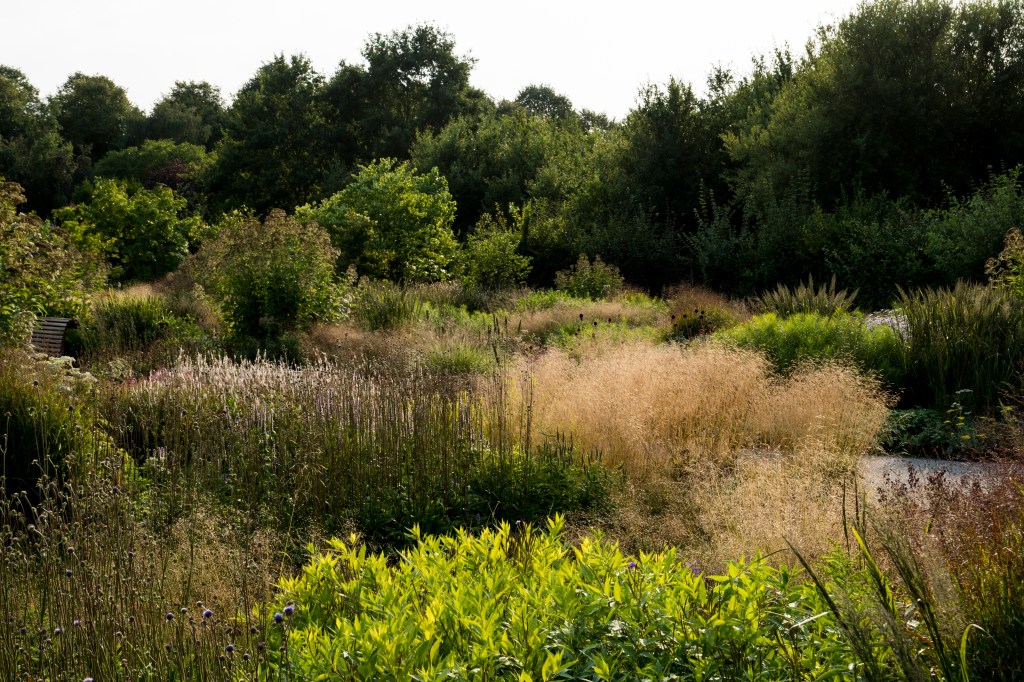
We’ve entered the time of the year when my dreaming about my garden reaches its zenith. The cycle of false spring and snowstorm, paired with the trickle-slow return of the light, always ignites this in me. I had checked out some gardening books by the lovely Piet Oudolf, a Dutch gardener I admire, and was poring over them as I drank my coffee on a recent morning. It was a tranquil, hopeful moment of dreaming about what might be. Later that morning, I sat in Quaker Meeting, preoccupied with the tension between the burgeoning springtime joy I have been experiencing and this moment that we find ourselves in, rife with violence, fear, and sweeping polarization. How do I hold it all, I wondered, without one excluding the other? How can joy lead to action and collective care? As I sat in silence, the gardens returned to me.
In particular, I was reminded of rain gardens. Oudolf and Noel Kingsbury wrote in their introduction to Planting: A New Perspective about the need to take into consideration the environment you are in— both what is possible and what is needed. They talked about the increasing trend of personal gardens that focus on the needs of the community, such as rain gardens that capture the rain and runoff and return it gradually to the water table. The right plants can absorb VOCs (Volatile Organic Compounds) and transform them back into simple CO2 and water. Nature is deeply resilient, and plants have been known to rapidly take over in abandoned industrial spaces, yielding a surprising diversity of plants in a place filled with trash and industrial waste.1
As I sat thinking about the terrible violence and upheaval of the past weeks— locally, nationally, and internationally, I wrestled once again with what to do about it. I find myself in a season where I feel like I am slowing coming back to life. I am finding joy, healing, and newness against a backdrop of so many people suffering. How do I reconcile this? How do I gratefully accept and cultivate this joy while remaining active and engaged in pushing back against the oppressive and destructive forces at work all around us? I looked at the community around me, silent in their faithful worship, and it dawned on me that a healthy community can function like a rain garden. It can absorb and metabolize the runoff that comes its way, softening the blow, filtering out what is harmful, and returning what is useful to the broader environment. While it is far from the full picture of what justice looks like, we can cultivate spaces like this in our backyards, both literally and metaphorically. We can become people who address the concerns that come our way, that work to sustain healthy internal ecosystems that return the nutrients necessary for a healthy and thriving community back into our immediate surroundings.
This metaphor unlocked something for me. One garden cannot stop climate change, or restore a whole ecosystem, but it can have a measurable impact on its surroundings. It might not prevent a landslide, but it might limit the effects of flooding on your street. It won’t remove harmful materials from your whole community, but it may make the soil and the air of your little slice of the world a tiny bit cleaner. The more people who plant with their community in mind, noting their specific context and the needs of their own tiny micro-climate, the more the needle shifts.
It is so easy to become discouraged when faced with the monumental scale of the challenges we face. We see the vast scope of the work that is needed, and we don’t even know where to start. It can feel insurmountable, and that feeling can easily daunt us into stopping completely. But what if we were to look at our own particular surroundings— the climate of the real places and people we find ourselves among— and think about what we might plant that can absorb in some tiny way some of the stew of hatred, fear, and harm that we find ourselves in? What do we have to offer that is resilient in the context in which we find ourselves? What does my literal neighbor need that I can share? Maybe it is listening to the pain and fear of someone who is suffering and offering them a kind ear and safe haven. Maybe it is using my voice to advocate in spaces where I have influence. Maybe it is sharing of my resources in a way that undermines our selfish, acquisitive economy. Or maybe it is literally planting a garden, something to filter the water, feed the bees, and bring a smile to the face of my neighbor.
This image also led me to wonder how our proximity to one another’s gifts might heighten the impact to our work. Oudolf and Kingsbury note in their introduction that “plants differ in their ability to break down specific VOCs, so combinations are often more effective than just one species.” Using deep knowledge of what each plant offers unlocks new possibilities, because “different species have different roles to play in a complex set of biochemical reactions.”. None of us has everything it takes to meet this moment on our own, but our chances are better when we work together, when we understand the specific terrain in which we find ourselves, and how our different capacities, skills, and resources might amplify one another. We won’t know this unless we are in proximity to one another, learning what we each have to offer, and trying different combinations and arrangements. It may not be much, but it is a real place to start.
It is also not insignificant for me that there is space for joy in a garden. There is beauty in the thing that is also enriching our oxygen, feeding our bees, absorbing water, and filtering chemicals. There is joy in community. There is joy in one another. There can even be joy in the work, as dark and difficult as it may be. But, at the end of the day, a garden starts with digging in and planting something in the waiting ground, even if it is just a tiny seed. Restoration in our communities can begin the same way.
- All quotes and references are from Planting: A New Perspective, by Piet Oudolf & Noel Kingsbury, p. 12 ↩︎
 Wellspring
Thank you, Anna.
❤️
LikeLike